
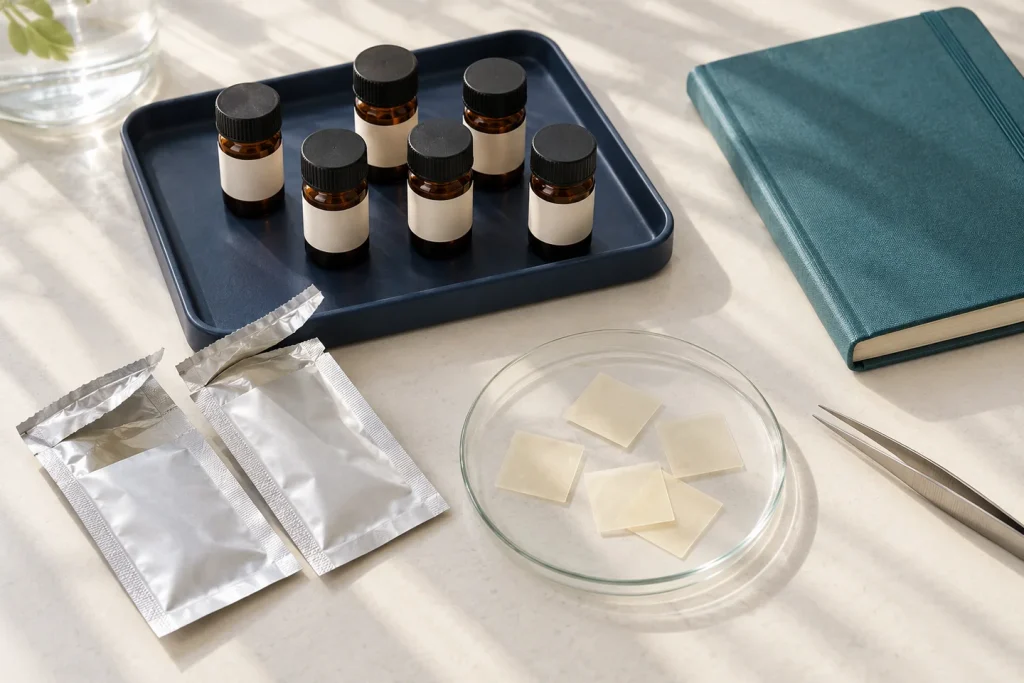
Image: a purpose-made editorial scene, not documentary evidence of a company facility or completed study.
For a probiotic pet oral film, a high starting count is not a complete product specification. Establish the exact strain, an appropriate viable-count method and evidence for the finished film through its proposed shelf life. Keep those quality records separate from species-specific safety, permitted-use and benefit-claim assessments.
Specify the strain, not just a familiar species name
A supplier brief should identify genus, species and strain code, plus the supplied preparation and its carriers. This lets a reviewer connect the material to the supporting documents rather than assuming that every preparation with a similar name is equivalent. Record any updated taxonomic name alongside the identifier used in the original evidence.
EFSA FEEDAP guidance on microorganisms used in feed additives addresses strain identification and culture-collection deposition in its application context. It also discusses compatibility where microbial additives encounter other additives with antimicrobial activity. These are reasons to ask precise identity and compatibility questions, not proof that a proposed finished film is authorized.
For procurement, request the manufacturer’s material code, current specification, lot COA and storage conditions. A replacement supplier should trigger a documented comparison. Our ingredient-qualification checklist explains how to keep identity, lot results and intended-use evidence separate.
Read the unit and the point in time beside the CFU number
A colony-forming-unit count describes viable organisms recoverable under the stated culture method. Ask whether the reported quantity is per gram of incoming powder, per strip or per serving, and whether it applies at manufacture or through expiry. The calculation and laboratory report should use the same basis as the intended specification.
ISAPP guidance on probiotic labels emphasizes strain identification and viable counts through shelf life. It also warns that a total count in a multi-strain mixture does not disclose each strain’s contribution. Its consumer-label examples concern human products; they are useful quality questions here, not pet-label law.
A calculation, not a dose recommendation
In a hypothetical example, a change from 1 billion to 100 million CFU per strip is a one-log decline: 10% remains and 90% has been lost. Neither number is a recommended pet dose, a HYTANBIO test result or evidence of efficacy. The example shows why a large starting number alone is uninformative.
Check the stages that the culture actually experiences
Map the proposed manufacturing route before promising that a probiotic preparation will work in an oral film. Identify when the preparation enters the mixture, how long it remains in each stage, which conditions it encounters and where representative samples can be taken. A powder supplier’s COA describes the incoming material, not the film after processing.
Ask the development team to propose a viability study covering the relevant transitions. The study should distinguish a processing effect from an analytical recovery problem. If a method cannot reliably recover organisms from the polymer and flavor matrix, an apparently low count may be difficult to interpret.
- Incoming preparation: identity, count basis and storage history.
- Relevant intermediate: documented exposure and sampling point.
- Finished film: suitable recovery and enumeration method.
- Packaged samples: identified time points and storage conditions.
This is a suggested study map, not a validated manufacturing recipe or a guarantee that every strain is suitable for film processing.
Ask what the enumeration method can distinguish
For a single-strain product, establish that the test is suitable for the final matrix and reports the agreed unit. For a blend, ask what the method can distinguish and what it combines into a total. A result should not be labeled “per strain” unless the method and reporting genuinely support that distinction.
| Document or result | Useful question | Unresolved by that document alone |
|---|---|---|
| Raw-powder COA | What entered the process? | Finished-film count |
| Finished-film total CFU | What was recoverable by this method? | Each strain’s contribution in a blend |
| Expiry-time packaged result | Did the tested pack meet its criterion? | Clinical benefit or another pack’s stability |
Agree how the laboratory will handle interference, reporting limits and unusual results. Keep the original data and investigation with the lot file. The buyer should be able to trace the headline CFU statement back to the tested sample and method revision.
Build the expiry claim around the finished packaged film
Set the proposed expiry, storage wording, packaging revision and acceptance criteria before beginning a stability program. The review should identify what evidence is available now and what is still being generated. A target of 12 or 24 months is a commercial brief, not a demonstrated shelf life.
Choose study conditions and time points with qualified stability personnel. Record film lot, sachet material, sealing conditions and sample custody so a later reviewer knows what the results cover. Review viable count alongside the other agreed product attributes. Do not extend the expiry solely because the first sample passed or because a different formulation remained acceptable.
If a project uses an initial count above its intended minimum, justify that choice from actual development evidence and safety and regulatory review. An arbitrary overage does not repair an unsuitable process or package. See water activity and moisture for another part of the stability specification.
Review market access and benefit wording independently
The European Commission feed-additive overview links to the EU Register and relevant authorization framework. For an EU project, establish the material’s category and check the applicable authorization, species and conditions where it is a feed additive. A scientific opinion, a culture-collection record and a finished-product marketing permission are not interchangeable documents.
For either an EU or US launch, have qualified reviewers assess the proposed ingredient use and exact claims. A study in people does not by itself establish a benefit in cats or dogs. Likewise, a viable-count report establishes a quality measurement, not a digestive-health outcome. Document which evidence supports each proposed statement and where the evidence stops.
HYTANBIO can receive a probiotic film development brief for feasibility review; this article does not represent a prevalidated probiotic formula. Supply the strain file, intended species, market, count basis, packaging concept and available studies before agreeing a commercial specification.
Buyer FAQ
Can a raw probiotic powder COA support the count on a finished strip?
It identifies the incoming lot and its reported count, but it does not establish survival through processing or storage. The finished film needs a suitable measurement and evidence for the period claimed.
Does a larger CFU count mean a better pet product?
Not by itself. The strain, intended use, evidence and viable amount relevant to that evidence matter. This guide does not recommend a dose for dogs or cats.
Is a total blend count enough to describe every strain?
No. A combined count does not establish each strain’s contribution. Ask which organisms the method distinguishes and keep any reporting limitations explicit.
Does a 30-strip carton imply a 30-day feeding program?
No. Pack count is a packaging choice. Serving instructions require product-specific safety, evidence and market review; they cannot be inferred from carton quantity.
Sources and review boundaries
This manufacturer-authored guide concerns development and procurement. It does not prescribe a strain or dose, establish efficacy, or claim an authorized probiotic product. Numerical examples are hypothetical. Check current destination-market rules and product-specific evidence.
- ISAPP: Decoding a Probiotic Product Label, updated June 2025
- EFSA FEEDAP: Characterisation of microorganisms used as feed additives or production organisms, 2018, amended 2024
- European Commission: Feed additives and the EU Register
References checked on 30 October 2026. Review this guidance when the formulation, process, packaging, intended use or cited requirements change. Corrections and evidence requests: info@hytanbio.com.