
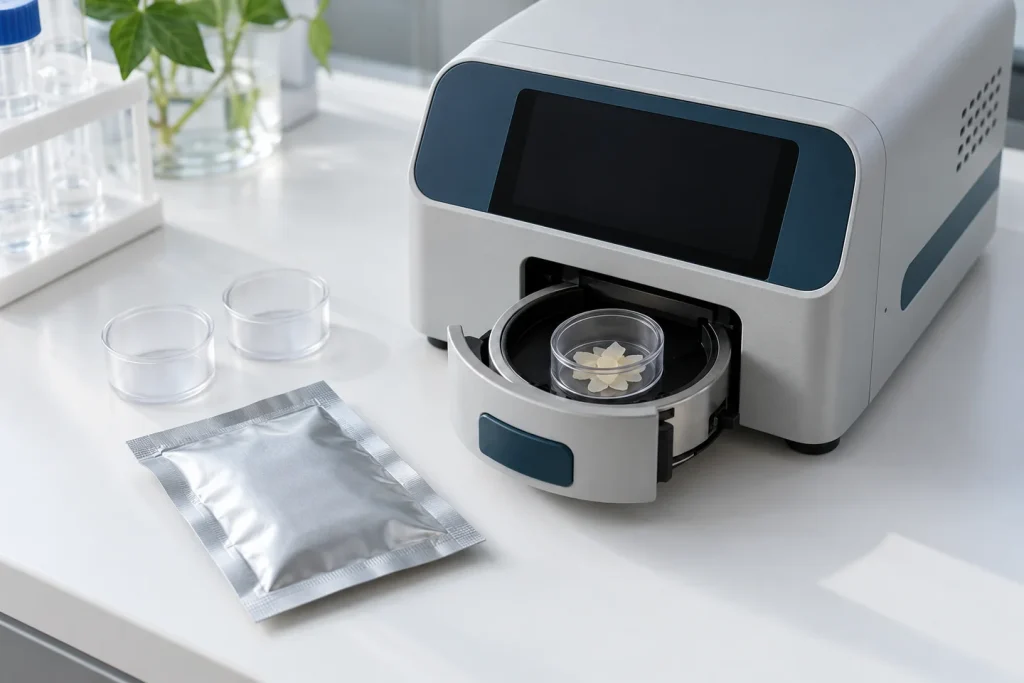
Image: a purpose-made editorial scene, not documentary evidence of a company facility or completed study.
Measure water activity and moisture content as different attributes. Moisture describes how much water a sample contains; water activity describes its equilibrium relationship with water vapor. Neither a dry feel nor one favorable reading establishes that a pet oral film is microbiologically safe or stable in its final pack.
Start with two separate specification lines
The FDA’s water-activity technical guide explains the equilibrium relationship as aw = ERH/100, where ERH is equilibrium relative humidity at the measurement temperature. Some water is bound to components of the material. Consequently, total water content and water activity are not interchangeable measurements. This physical explanation comes from an older technical guide, not a new pet-film regulation.
For example, an equilibrium relative humidity of 60% corresponds to an aw of 0.60. This is a worked conversion only, not a measured HYTANBIO result or a recommended release limit. A moisture result of “6%” cannot be inserted into that equation as though it were ERH.
Request distinct method names, reporting units and acceptance rationales. If the moisture result comes from loss on drying, ask what the method actually measures in the specific formulation. Keep the analytical basis visible in the specification.
Use published thresholds in their proper context
FDA CVM Guidance for Industry #245, section 4.5.3, groups animal foods by water activity: above 0.85, between 0.60 and 0.85, and below 0.60. It also discusses other controls and the possibility of yeast and mold growth at lower water activities. These categories help frame a hazard assessment. They are not a ready-made acceptance specification for every pet oral strip.
Ask a qualified food-safety reviewer which hazards are relevant to the ingredients and process, and what evidence supports the selected controls. A finished-product water-activity reading does not document a pathogen-kill step or exclude contamination introduced during handling. Low water availability and demonstrated microbial control answer different questions.
Also keep commercial shelf life separate from microbial growth considerations. A film may fail a handling, ingredient-content or packaging requirement before the intended expiry even when its water-activity result meets the agreed criterion.
Make sample handling part of the method
Specify where the sample comes from and how it reaches the instrument. A freshly cut film, an exposed film awaiting packing and a film removed from a sealed sachet represent different points in the process. Comparing them without recording that history can turn a sampling difference into an apparent manufacturing trend.
Include these fields in the laboratory request
- Lot and film revision, with the sampled process stage.
- Unit count and whether strips are tested separately or combined.
- Time of sachet opening and elapsed time before measurement.
- Sample preparation, cup loading and equilibration procedure.
- Measurement temperature, instrument identification and verification record.
- Result, method revision and handling deviations.
FDA’s technical guide emphasizes temperature control in water-activity measurement. Use the selected instrument’s suitable procedure and a laboratory-approved method rather than inventing a universal waiting time. If sample size is limited, agree the approach before the laboratory consumes the available material.
Investigate disagreement instead of choosing the favorable result
If moisture content passes while water activity fails, do not discard one result merely because the other looks reassuring. First verify sample identity and the methods used. Then review preparation, conditioning, instrument checks and whether the tests describe comparable material. Document the investigation before deciding what the result means for the lot.
| Observation | First review question | Decision to avoid |
|---|---|---|
| Water activity changes after opening | Was exposure time controlled? | Blaming the production process without checking handling |
| Moisture passes, water activity fails | Are both methods and samples correct? | Treating moisture as a substitute result |
| Fresh samples pass, stored packs fail | What changed during the packaged study? | Extending expiry from release data alone |
The response may include retesting under a justified investigation, reviewing packaging or revising a development formulation. Set the disposition authority in advance. A new specification should not be applied retrospectively simply to make an existing failure disappear.
Test the film in the packaging that will be sold
Define whether the stability sample is an individually sealed sachet, a grouped pouch or another agreed presentation. Record the packaging material and seal-process revision with the film lot. A result from a laboratory container cannot automatically establish behavior in the retail pack. The sachet-validation guide separates material-barrier data, seal strength and package integrity.
For a practical study, agree time points and storage conditions before starting, then review water activity alongside the other product-specific criteria. Include appearance and handling, relevant ingredient measurements and the agreed microbiological assessment. The study should be designed by qualified personnel for the actual formula and distribution conditions.
HYTANBIO’s stated 20- or 30-strip box options describe pack counts. They do not establish moisture protection or an expiry period. If the primary sachet or sealing process changes, assess whether the previous packaged data still cover the revised version.
Give purchasing a usable release specification
The final document should show the property being controlled, the approved method, a justified range or limit, the sampling plan and the decision owner. Separate routine release tests from development investigations and stability monitoring. This helps a buyer understand why a test appears on a COA and what evidence sits elsewhere in the technical file.
For a new pet oral film OEM project, ask the manufacturer to explain the proposed specification rather than supplying a target copied from an unrelated food. If the evidence is incomplete, record the development question and the next study needed. Mark a provisional target as provisional until the supporting work is reviewed.
- Approve the measurement and sampling procedures.
- Link proposed criteria to the formula, process and risk assessment.
- Review results in the final intended packaging.
- Define investigation, release and change-control responsibilities.
Buyer FAQ
Is water activity the same as moisture percentage?
No. Water activity is an equilibrium vapor-pressure relationship, expressed without units. Moisture content reports water quantity on a stated analytical basis. One cannot generally be converted to the other without additional material-specific information.
Is a water activity below 0.60 enough to approve a pet oral film?
No. The FDA category is useful context, not a complete release decision. Ingredient hazards, process controls, contamination risks, packaging and other product criteria still need assessment.
Does a dry, non-sticky film prove acceptable water activity?
No. Appearance and handling observations do not replace measurement with a suitable method. Record physical attributes and analytical results separately.
Should the test be repeated after changing the sachet?
Assess the change first. A different primary pack or seal process may affect the relevance of previous stability evidence. Define the required follow-up work through documented change control.
Sources and review boundaries
This article offers manufacturer-authored specification-planning advice. It does not set a universal microbial limit, report company test data or replace a qualified hazard analysis. The illustrative calculation is not a product result.
- FDA: Water Activity (aw) in Foods
- FDA CVM GFI #245: Hazard Analysis and Risk-Based Preventive Controls for Food for Animals, July 2022
References checked on 30 October 2026. Review this guidance when the formulation, process, packaging, intended use or cited requirements change. Corrections and evidence requests: info@hytanbio.com.