
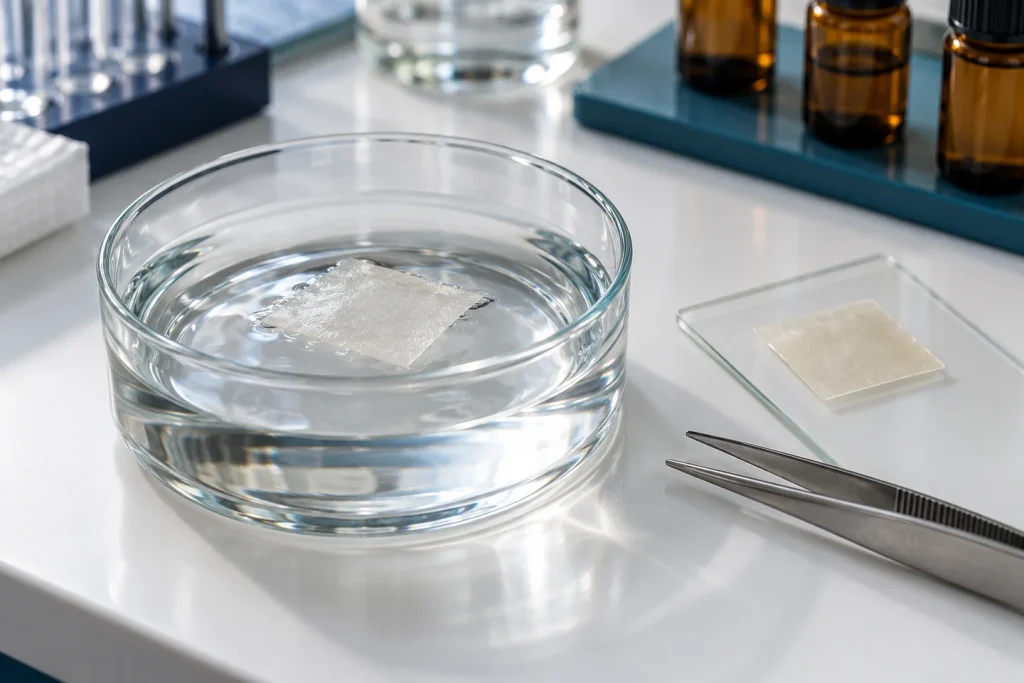
Image: a purpose-made editorial scene, not documentary evidence of a company facility or completed study.
A pet oral strip breaking apart quickly does not establish how much of an ingredient dissolves, where it is absorbed or whether it produces a benefit. Specify these as separate questions. A supplier demonstration is useful for screening, but a purchasing specification needs a defined endpoint and a reproducible method.
Name the endpoint before comparing two films
Disintegration describes the loss of an intact physical structure. Dissolution concerns material entering solution. Absorption concerns passage into the animal’s body; the route and extent need evidence for the constituent and proposed use. A transparent film can become hard to see before every component has dissolved. Conversely, some dissolved material may be present while a visible polymer fragment remains.
In the human drug framework, 21 CFR 314.3 defines bioavailability in terms of rate and extent of availability at the site of action. That definition explains why a physical breakup test cannot establish bioavailability. It does not classify a pet wellness film as a drug or provide a veterinary testing protocol.
Ask the supplier what the reported number actually measures. If the answer is “the strip disappears,” agree whether that means first rupture, no visible sheet, no detectable fragments or analytical recovery in the liquid. Those endpoints may produce different times.
Turn a demonstration into a repeatable test
A video of one pet oral strip in a glass of water leaves important variables unknown. Record the sample revision, dimensions, thickness or unit mass, conditioning history, liquid composition and volume, temperature, agitation, placement and timing rule. The written method should allow a second laboratory to understand what was done without watching the operator.
Keep the method with the result
- Identify the lot, sample position and number of separate units tested.
- Define when timing starts and what observation stops it.
- Record the medium and equipment settings rather than using “normal conditions.”
- Report individual results, any incomplete breakup and the agreed summary statistic.
- Document deviations, photographs where useful and the investigation rule.
For quantitative dissolution, also define the measured constituent, sampling times and analytical recovery. The laboratory should assess whether the film matrix, flavor or sample filter affects the measurement. A clear liquid alone is not an assay result.
Why 30 seconds is not a universal pet-strip requirement
The FDA’s 2008 guidance on orally disintegrating tablets recommends an in-vitro disintegration time of approximately 30 seconds or less for the human ODT designation and explains the context of that recommendation. The document concerns tablets developed under the human drug framework. It is not a universal acceptance standard for dog or cat oral films.
For a private-label pet strip project, first decide what practical behavior the product needs and how it will be assessed. Then agree a method and an acceptance criterion appropriate to the formula, species, intended administration and product classification. Do not choose a number because it appears on a competitor’s product page.
Two suppliers quoting the same time may be using different volumes, temperatures or endpoint rules. Compare the methods before ranking the samples. If method details are unavailable, record the result as a demonstration rather than comparable qualification data.
Read a test report without adding claims it cannot support
A useful review separates what was observed from the conclusion being proposed. This prevents an engineering result from turning into an unsupported absorption or health claim when the report reaches the marketing team. The table below is an editorial evidence check, not a regulatory classification tool.
| Evidence supplied | What it can address | What remains unresolved |
|---|---|---|
| Timed physical breakup test | Behavior under the recorded bench conditions | Ingredient recovery, animal acceptance and uptake |
| Analytical dissolution profile | Measured constituent entering the sampled medium | In-vivo absorption or clinical benefit |
| Species-specific administration observation | Handling and acceptance within that protocol | Bioavailability unless separately measured |
A proposed statement such as “fast acting” needs its own supporting evidence and market review. Keep the underlying report attached to the exact claim wording, including the tested formula and conditions. Changing the claim after approval can change the evidence needed. Our claims-substantiation guide covers that review.
Control film geometry and sample history
HYTANBIO’s stated project formats are commonly 2 × 2 cm, with dimensions up to 2 × 3.5 cm and cartons of 20 or 30 strips. These are format options, not validated disintegration times or ingredient doses. When comparing versions, identify which dimensions and mass were actually tested.
For a development comparison, change one planned factor at a time where practical, or document a design that can separate several effects. A change in film size accompanied by a change in thickness, flavor and storage history makes a simple time comparison difficult to interpret. Keep an approved reference sample and method revision with the project file.
Ask whether the behavior has been assessed after relevant storage, not only immediately after manufacture. Define how long samples may remain outside their sachets before testing. For the dimensional calculation behind a formulation brief, see oral-film loading and mass balance.
Write a purchase brief that closes the evidence gap
Give the manufacturer the intended species, market, administration concept and exact performance question. Request a proposed test method before setting a commercial promise. If the project includes a nutritional or other functional ingredient, identify which constituent should be measured and why that result matters to the specification.
Keep bench performance, animal-use evaluation and claim support in separate approval fields. A pass in one field should not automatically release the others. When a method or formulation changes, document which earlier results remain applicable and which need repeating. This is especially important when a sample demonstration is used months later to describe a revised commercial formula.
- Agree the endpoint and method revision.
- Review results from identified samples and investigate exceptions.
- Approve only the performance statement supported by those results.
- Define what triggers retesting during scale-up and change control.
Buyer FAQ
Does a fast-dissolving pet strip guarantee faster absorption?
No. Breakup or dissolution in a test liquid does not establish uptake in a dog or cat. An absorption claim needs evidence appropriate to the ingredient, species, formulation and intended use.
Must every pet oral film disintegrate within 30 seconds?
No universal pet-film requirement is established by the cited FDA ODT guidance. Its approximately 30-second recommendation concerns a human tablet designation. Define a justified method and criterion for the actual project.
Can a water-glass video qualify an OEM supplier?
It can help screen samples, but it is incomplete qualification evidence without the sample identity, test conditions, endpoint, repeated results and agreed acceptance criteria.
Can a 2 × 2 cm strip and a 2 × 3.5 cm strip share one test result?
Do not assume so. Identify the tested geometry, mass, composition and conditioning history. A documented comparability assessment should decide whether results cover another version.
Sources and review boundaries
This manufacturer-authored guide provides test-planning questions, not veterinary administration advice or a report of measured HYTANBIO performance. Human drug references explain terminology and scope; they are not presented as automatic requirements for pet feed products.
- FDA: Orally Disintegrating Tablets, December 2008
- 21 CFR 314.3: definitions, including bioavailability
References checked on 30 October 2026. Review this guidance when the formulation, process, packaging, intended use or cited requirements change. Corrections and evidence requests: info@hytanbio.com.